
From News Desk
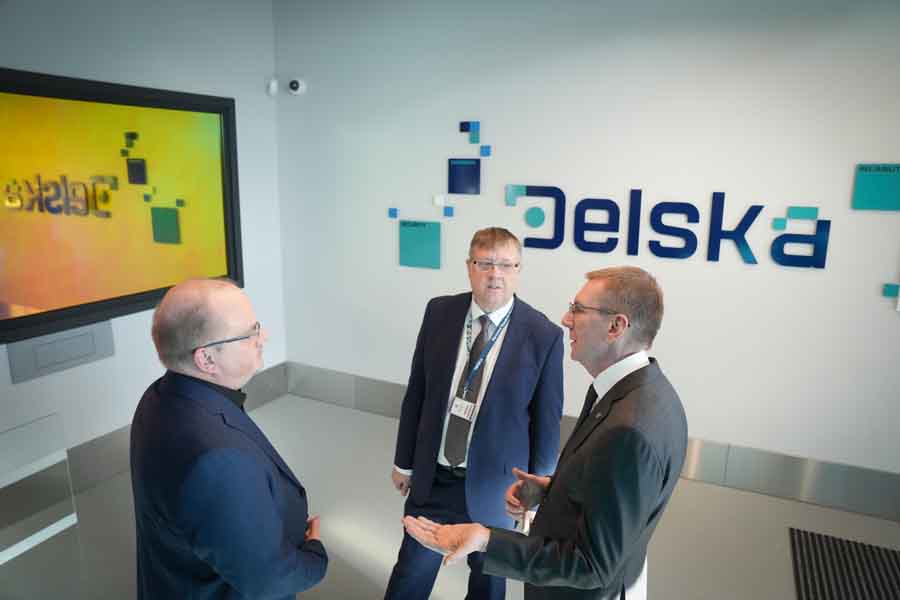
The President of Latvia, Edgars Rinkevics, visited Delska’s commissioned 10 MW datacentre in Riga, ahead of its official launch. Delska CEO Andris Gailitis and CTO Rihards Kaletovs presented the facility and discussed its role in supporting AI and high-performance computing (HPC) workloads, as well as European digital sovereignty.
Gailitis outlined global trends shaping the datacentre sector, including rapid adoption of AI and rising pressure on power availability in Europe’s established hubs. With capacity constraints, companies are relocating infrastructure to regions with energy access and room to scale. In this context, the Baltic states’ growing competitiveness as datacentre locations was highlighted. The new Delska facility, developed with an investment exceeding 30 million euros, demonstrates strong export potential and its ability to attract international customers.
Sustainability was a central theme of the visit. The datacentre is powered entirely by renewable energy from Northern European wind farms, solar parks and hydroelectricity, likewise all Delska facilities in Latvia and Lithuania. Backup generators run on Neste MY Renewable Diesel, while electricity generated during maintenance will be redirected to consumers to reduce waste. Delska is in discussions with Riga’s municipal heating company on waste heat reuse to supply residential buildings.
Built to achieve power usage effectiveness below 1.3, the facility uses hot-aisle containment, advanced free-cooling solutions, Weiss Technik Vindur CoolWll systems and Trane chillers. It supports both air and direct-to-chip liquid cooling for high-density GPU workloads.
The datacentre is Uptime Institute Tier III Design certified and is scheduled for Tier III Facility Certification in March. The official opening event for EU North Riga LV DC1 is scheduled for April 8th.
“Datacentres located in Latvia are essential for the development of technology companies and for the country’s digital resilience. Therefore, it is important for the state to recognise not only the challenges but also the opportunities offered by datacentre service providers in strengthening Latvia’s competitiveness. What we have seen and discussed with the company’s representatives today demonstrates that the company has taken a forward-looking approach in planning the capacity of the new datacentre and developing a sustainable and energy-efficient infrastructure to ensure uninterrupted service provision for its clients,” said President Rinkevics after the meeting.
Already recognised by professionals and prospective customers, the facility is one of the most advanced datacentres in the Baltics. The 7,100-square-meter modular site supports up to 250 kW of rack capacity and is designed for long-term growth, with secured grid power and the ability to expand up to 30 MW on acquired land.
Perspective
Running advanced tech facilities on sustainable resources and simultaneously cutting carbonisation is a big challenge in the tech field today. Using solar, wind and hydroelectric power can be an innovation step in meeting this challenge, especially as the world continues to advance in technology despite facing rising energy constraints.
At the same time, caution needs to be taken that these sources of energy are continuously harmonised with each other and there are no power outages. As the capacity of datacentre is increased, more of the renewable resources are needed to continue to generate more power without break. These calculations must be in place to make these datacentre sustainable in the long run.
 News and Opinions...