
From News Desk
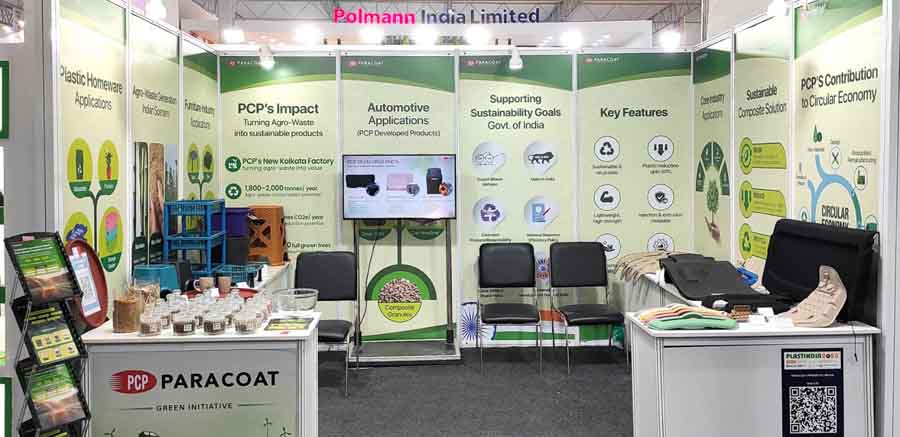
Paracoat Products, an NVH solutions manufacturer is showcasing agro-material reinforced polypropylene composite masterbatch granules at Plast India Expo 2026, taking place from February 5th–10th. This innovation positions the company in the sustainable eco-efficient material solutions segment for the automotive and industrial sectors.
Plastic waste has emerged as one of the most pressing global environmental challenges, with India at the forefront of this crisis. The country currently generates an alarming 9.3 million tonnes of plastic waste annually, accounting for nearly 20 percent of the world’s total plastic pollution. This mounting problem not only threatens ecosystems but also places immense pressure on India’s waste management systems and climate commitments.
Paracoat addresses this challenge with composite granules developed using agro waste generated from jute, bamboo, wheat and rice cultivation enabling up to 50% reduction in plastic consumption. By converting agro-waste into valuable raw material, the company is helping India tackle two critical challenges –
1 – Reducing reliance on fossil fuels and
2 – Preventing the burning of agricultural residues, a major contributor to air pollution.
The innovation delivers 24% lower CO₂ emissions as compared to virgin plastics, aligning with India’s climate action goals and commitment to sustainable industrial growth. Engineered for integration with injection and extrusion technologies, the granules can be blended effortlessly with existing polymer formulations. Manufacturers gain the flexibility to customise bio-filler loading while maintaining superior mechanical properties, dimensional stability and productivity.
Rajesh Poddar, CEO, Paracoat Products said, “At Paracoat Products, we believe the future of plastics must be defined by harmony between ecological balance and technological innovation. By harnessing agricultural residues as bio-fillers in our thermoplastic composites, we are setting new benchmarks for sustainable manufacturing. This initiative not only cuts carbon emissions but also directly supports India’s vision for a circular economy while tackling the pressing issue of air pollution caused by burning agro-waste.”
Paracoat is embedding this sustainability breakthrough into its own product portfolio, with applications across parcel shelves, door trims, cladding covers and other automotive and industrial components. By integrating agro-material composites into its products, Paracoat demonstrates how Indian industry can lead by example in advancing the government’s vision of “Reduce, Reuse, Recycle” while fostering innovation-driven growth.
With this launch, Paracoat Products reinforces its role as a sustainable innovator. The company’s participation at Plast India Expo 2026 will highlight how industry-led initiatives can accelerate India’s transition toward eco-efficient manufacturing, reduce plastic dependency and create value from agricultural residues in line with national priorities.
Perspective
Innovations such as these can decrease plastic usage in applications suggested above. However, 2 considerations are paramount to make this successful –
1 – To ensure enough availability of the raw materials from which this product is made, so that a country-wise usage can be promoted
2 – The remaining usage of plastic still is a matter of concern. Hence, a systematic plan needs to be devised to replace plastic usage with sustainable material at a scale of the population of India
In time, effort should be made to popularise such products outside India as well, so that plastic usage can be replaced by sustainable material.
Only by devising a systematic plan in this direction can plastic be seriously replaced. Government must promote such innovations on a large scale.
 News and Opinions...