
From News Desk
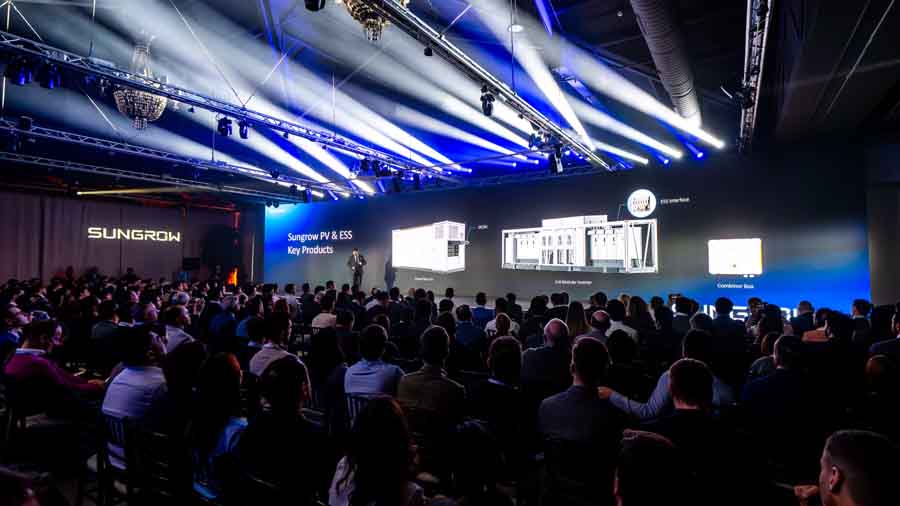
Sungrow, a PV inverter and energy storage system (ESS) provider, has launched two innovations for the European market at its PV & ESS Summit in Madrid viz., the utility scale battery energy storage system (BESS) PowerTitan 3.0 and a Single-Platform Design for DC-Coupled PV-ESS Solution. The event brought together more than 300 partners and industry experts, including representatives from SolarPower Europe, TÜV and DEKRA, to explore emerging technologies and market trends.
PowerTitan 3.0: Next-Generation Utility ESS
PowerTitan 3.0 was designed to be a forerunner in facing the challenges of a modern energy system. A single 20-foot container integrates 1.78 MW PCS with 7.14 MWh batteries, enabling a 4-hour configuration where one block reaches 7.2 MW/28.5 MWh. It features 600Ah+ stacked battery cells, supporting a 2-8hour duration. The stacked battery cells provide higher safety and efficiency and contribute to a system-level round-trip efficiency (RTE) of 92%.
PowerTitan 3.0 is pre-installed and -commissioned at the factory thanks to its AC block design and also supports self-configuration and self-checks within one hour. This enables a 1 GWh project to be deployed in just 12 days. The system operates without derating at temperatures as low as -40°C, making it suitable for Nordic and Alpine regions, as well as for coastal and high-humidity areas.
Single-Platform Design for DC-Coupled PV-ESS Solution
Together with the PowerTitan 3.0 Sungrow introduced the Single-Platform Design for DC-Coupled PV-ESS Solution, featuring a 1+X modular inverter with a dedicated energy storage interface, PowerTitan 3.0 with a built-in DC/DC module; and a self-developed PV-ESS Synergy Management System. The integrated architecture not only enables a long discharge duration of up to 8 hours; and offers a flexible ESS power ratio up to 100%, but also delivers system-level cost optimisation.
Grid-forming technology is becoming a key enabler of resilient and stable power systems. At the summit, Dr. Henry Liu, Director of Sungrow’s Grid Solution Department, highlighted its growing role in supporting renewables-rich grids and meeting evolving EU standards. Sungrow presented its core capabilities, including voltage and frequency support, oscillation damping, GW-level black start and system strength support. These capabilities have been validated in landmark projects, including the 7.8 GWh project in Saudi Arabia – a large grid-forming energy storage plant.
Opinion
Implications
With the EU making an emphasis on transiting to renewable energy systems and cutting carbonisation, this BESS form can help Spain to move closer towards that goal. As a member of EU, Spain is obliged to execute decarbonisation methods.
Cautions
While BESS is an effective method of decarbonisation, it may lead to another ecological problem in the long run. As expire batteries accumulate, disposing them off may become a large ecological problem in future.
Hence, BESS installation organisations should evolve technologies to dispose off the retired batteries in a clean manner. The countries that are moving towards BESS should also look into this aspect.
 News and Opinions...