
From News Desk
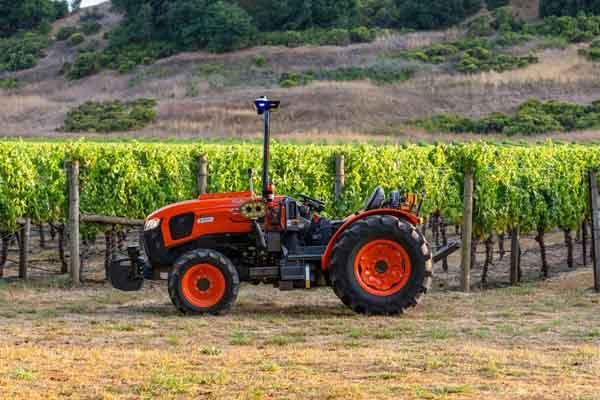
This year, Kubota announced the commercialisation of a smart, integrated autonomous solution developed in partnership with Agtonomy for the specialty crop market, fully built into the 105.7-horsepower diesel Kubota M5 Narrow tractor with advanced sensing and AI. Designed for reliability and versatility, this innovation helps customers work more efficiently.
Kubota also introduced a concept versatile platform ‘transformer’ robot (KVPR) that expands, contracts and moves along every axis, delivering the adaptability of multiple machines in one intuitive solution. This versatility supports customers across different operations and seasons, making work simpler and more enjoyable. In addition, Kubota showcased a Digital Twinning system designed for real-time, persistent data monitoring, whether tracking a single bud or managing an entire operation. These innovations reflect Kubota’s vision to solve big challenges with smarter, more compact solutions that prioritize the human experience.
“Big challenges don’t just need big machines; they need smarter solutions that make life easier,” said Todd Stucke, GM, Agri Solutions Headquarters, Kubota Japan (KBT); and President, Kubota North America. “Our go-to-market solutions are the culmination of our customer-driven innovation cycle, where the goal is not simply to automate what you’ve always done, but to rethink how work can be done more intuitively and efficiently.”
Kubota’s approach to commercialisation prioritises customer choice and the human experience. Rather than simply automating traditional workflows, Kubota designs smart and flexible machines that let customers work the way they prefer, whether in the seat or with the swipe of a finger, while maintaining the performance and ease of use they expect.
“Physical AI is a key inflection point for our industry and for Kubota,” said Brett McMickell, CTO, Kubota North America. “Decision-making, obstacle detection; and voice recognition capabilities mean AI real-time insights will now inform tasking, labour assignments and efficiency improvements. This is just the beginning of what is possible when you design technology for human needs, enhancing the way customers live and work rather than focusing only on technical capability. We can now facilitate more complexity with more certainty and more simplicity than ever before.”
Disclaimer – The details expressed in this post are from the companies responsible for sending this post for publication. This website doesn’t endorse the details published here. Readers are urged to use their own discretion while making a decision about purchasing or using a product/service related to this company, or using this information in any way. There has been no monetary benefit to the Publisher/Editor/Website Owner for publishing this post and the Website Owner takes no responsibility for the impacts of purchasing or using these products/services on the reader, or using this information in any way.
 News and Opinions...