
From News Desk
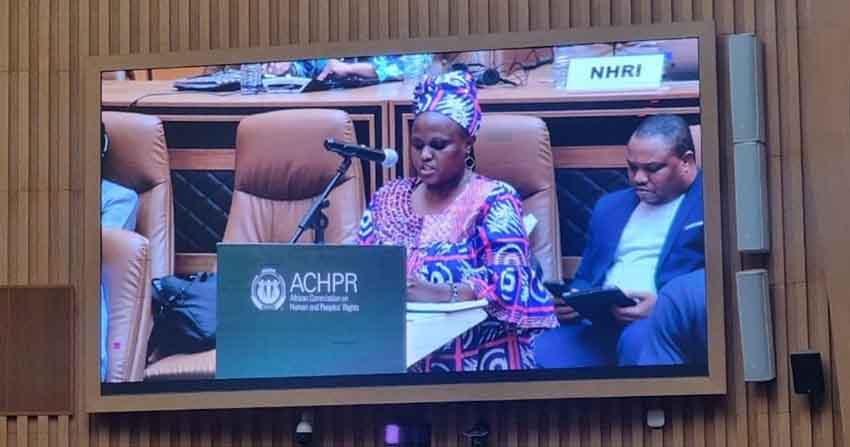
At the African Commission on Human and Peoples’ Rights (ACHPR) 85th Ordinary Session, women’s rights organisation Equality Now issued a stark warning – women and girls across Africa continue to suffer serious human rights violations due to state inaction.
Equality Now urges all African governments to urgently enact and implement comprehensive measures to fulfil their legal obligations to uphold women’s and girls’ rights, outlined in key regional human rights instruments, including the African Charter on Human and Peoples’ Rights and the Protocol on the Rights of Women in Africa, widely known as the Maputo Protocol. Human rights lawyer Deborah Nyokabi delivered Equality Now’s statement to the ACHPR, highlighting where states are falling short of their commitments.
Equality Now’s report, Barriers to Justice – Rape in Africa, Law, Practice and Access to Justice, revealed that while rape is one of Africa’s most pervasive crimes, the majority of cases don’t make it to court; and even fewer result in a conviction. Gaps in laws and weak enforcement, under-resourced judicial systems, limited political will and pervasive victim-blaming and discrimination foster a culture of impunity that emboldens perpetrators.
Sexual exploitation and trafficking are pervasive across Africa, fuelled by poverty, conflict, climate change, displacement, and cross-border trafficking. Although legal instruments exist, enforcement is inconsistent and better-coordinated regional action is urgently needed.
Governments must move from commitment to implementation by harmonising and strengthening anti-trafficking laws, ensuring reparations for survivors, and investing in specialised justice mechanisms and survivor-centred services, the report asserted.
The rise of anti-gender rights movement is jeopardising legal protections for women and girls and threatening to undo decades of legal progress, endangering the well-being of millions. These efforts are not occurring in isolation. Well-funded international networks are increasingly influencing, coordinating with, and empowering African actors who oppose gender equality.
At a regional convening in Kenya in June 2025, ultra-conservative campaigners from the US and Europe joined African counterparts to advance an agenda framed as “promoting and protecting the sanctity of life, family values and religious freedom.” In practice, their regressive plan contests reproductive healthcare, comprehensive sexuality education, and LGBTQ+ rights.
Emerging from the convening is the ‘Draft African Charter on Family, Sovereignty and Values.’ Composed without participation from women’s rights organisations, this charter promotes a narrow model of the “traditional family” and womenhood rooted in rigid, hierarchical gender roles that discriminate against women, girls and LGBTQ+ individuals. It disregards diversity in family structures and aims to eliminate essential protections for family life and marriage equality.
Anti-gender rights ideology ignores the reality documented in Equality Now’s report, Gender Inequality in Family Laws in Africa, which identifies how family life for many women and girls is blighted by control, violence, discrimination and marginalisation.
Those striving to end FGM reject assertions that the practice is cultural or religious, emphasising that no tradition or religion can justify violating the rights, health, and safety of women and girls.
Equality Now calls on every African government to fully enforce existing anti-FGM laws and swiftly introduce legislation where legal protections are lacking.
Nyokabi concludes, “Africa’s civil society urges ACHPR Member States to uphold their binding commitments. Legal equality for women and girls is not optional. It is a prerequisite for lasting peace, development and justice.”
Disclaimer – The details expressed in this post are from the companies responsible for sending this post for publication. This website doesn’t endorse the details published here. Readers are urged to use their own discretion while making a decision about using this information in any way. There has been no monetary benefit to the Publisher/Editor/Website Owner for publishing this post and the Website Owner takes no responsibility for the impacts of using this information in any way.
 News and Opinions...