
From News Desk
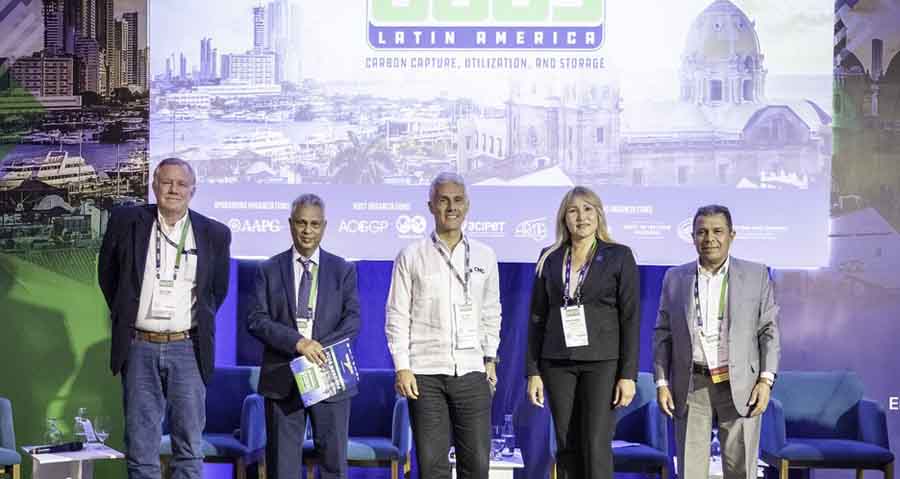
The Society for Low Carbon Technologies (SFLCT), whose footprint spans from Pakistan to Panama, reaffirmed its regional commitment to advancing carbon management in the Americas by endorsing the second Carbon Capture Utilisation and Storage (CCUS) Latin America Conference, held in Cartagena, Colombia. This follows SFLCT’s formal endorsement of the inaugural CCUS Latin America Conference in 2024, hosted in Rio de Janeiro and backed by the Brazilian government, which convened 172 organisations and 19 countries.
SFLCT’s collaborative back-to-back endorsements enhanced regional momentum for low-carbon coordination, grounded in its involvement with Brazil’s CCUS law and extending to its role in the government-backed decree announced during the United Nations’ COP30 as part of the Executive Technical Subcommittee on CCUS. This was further demonstrated by Professor Raffie Hosein, a member of SFLCT’s advisory board and Coordinator of CCUS–Collaborate (CCUS-C) at The University of the West Indies and The University of Trinidad and Tobago, who delivered notable technical contributions at COP30 and during CCUS LATAM.
The 2025 conference convened 109 organisations from 17 countries. Keeping with the theme of Colombia, it functioned as a regional forum where executive discussions, technical presentations and dedicated spaces converged to advance Latin America’s CCUS readiness. The structure emphasised catalytic dialogue, aligning with the region’s accelerating need for coordinated CCUS deployment.
Importantly, this arc for Colombia served as a continuation of SFLCT’s leadership of a marquee 2025 US convening held months earlier in Houston, supported by the same technical societies which were key in launching the CCUS Latin America Conference, with the Houston convening functioning as its US counterpart. These include the Society of Petroleum Engineers, the Society of Exploration Geophysicists; and the American Association of Petroleum Geologists. The repeated collective alignment underscores a shared technical foundation and reflects growing hemispheric collaboration on CCUS.
SFLCT’s Chairman of the Board noted, “The event’s structure reflects what the SFLCT is witnessing across the region: priorities aligning with actionable initiatives that reinforce coordination on carbon management and genuine partnerships.” This momentum was also reflected in the participation of SFLCT advisory board member Cecilia Romeu, a representative of Uruguay’s National Energy Company, who is featured in the opening image, underscoring the organization’s geographic diversity and regional presence.
Reflecting on the event’s momentum, SFLCT expressed appreciation to all participants and partners who shaped the 2025 programme, emphasising that deepening cooperation is essential to sustain and expand progress as Latin America and the Caribbean align their development objectives with low-carbon pathways. SFLCT’s forward posture, anchored in its global mandate, underscores a clear commitment to driving the policies, technologies, economic instruments, public engagement, and multisectoral partnerships needed to deliver a low-carbon transition at scale.
Disclaimer – The details expressed in this post are from the companies responsible for sending this post for publication. This website doesn’t endorse the details published here. Readers are urged to use their own discretion while making a decision about using this information in any way. There has been no monetary benefit to the Publisher/Editor/Website Owner for publishing this post and the Website Owner takes no responsibility for the impacts of using this information in any way. The views expressed are those of the SFLCT, a US-based 501(c)(3) nonprofit organisation; and do not necessarily reflect the positions of any external organisations referenced herein.
 News and Opinions...