
From News Desk
The Education Above All (EAA) Foundation, a global education foundation, is addressing the impact of climate change in Asia, supporting students in Cambodia and Vietnam to stay in school, learn climate resilience skills; and safeguard their futures.
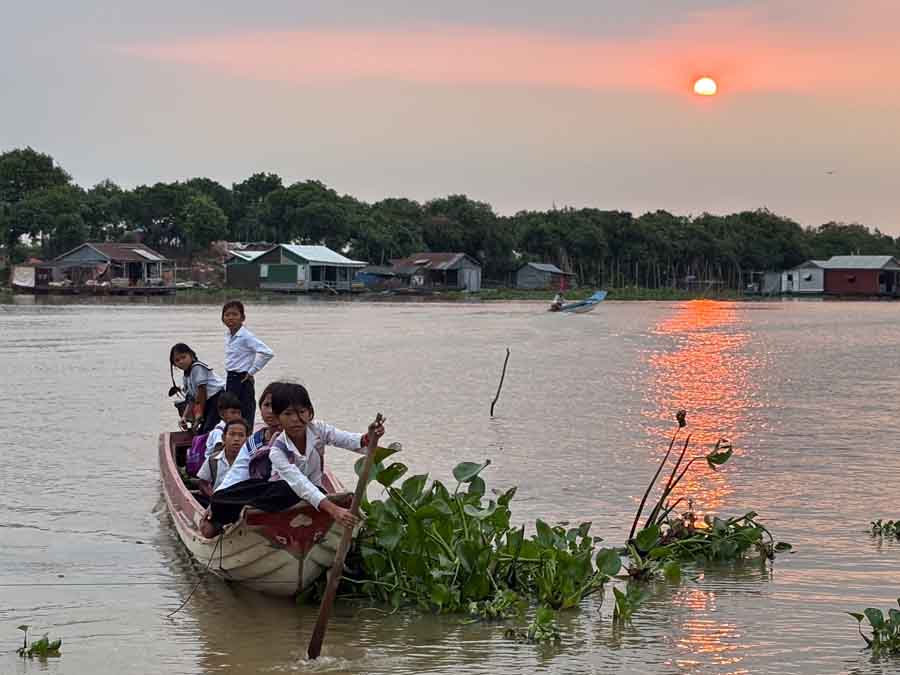
Ten-year-old Ren Naren lives on Cambodia’s Tonle Sap Lake. Each morning, instead of taking a bus or walking to school, she boards a small wooden boat. The lake has long supported her community, but inconsistent water levels now make her daily trip to school more dangerous and uncertain. Her elder sister, Rin Nary, was forced to drop out after contracting meningitis. Her situation highlights where poverty, access to education and health dynamics intersect, and how climate change exacerbates these challenges.
“Climate change has significantly impacted children’s ability to attend school, particularly due to prolonged rainfall and extreme heat,” said Roeum Phalla, Park Ranger Officer in Cambodia’s Tonle Sap region. “These conditions increase the risk of illnesses and accidents, making education increasingly fragile.”
In Asia, climate change is no longer a looming threat. It is affecting the region with intensifying typhoons, floods, droughts and heatwaves.
Climate disasters disrupting education in the past year has underscored the vulnerability of students in Asia –
– Super Typhoon Yagi struck Vietnam in September 2024, killing over 300 people and injuring nearly 2,000. Over 1,600 schools were damaged, leaving nearly 960,000 children facing learning disruptions due to school closures and loss of educational supplies.
– Each year, floods alone disrupt the education of some 30,000 Cambodian children.
– A record heatwave forced shorter school days and triggered blackouts, leaving classrooms unbearably hot. Scientists also warned that record-low Himalayan snowfall is shrinking the Mekong River and threatening the Mekong Delta region, a lifeline for food and livelihoods for millions in Vietnam and Cambodia.
“These overlapping crises show that climate change is not just an environmental issue, it is a classroom crisis, a health crisis and a family crisis,” said George Tavola, Engagement Manager, Education Above All Foundation.
Back to the Classroom for Out of School Children
In response, the EAA Foundation, in partnership with Aide and Action, has implemented a range of initiatives –
– Providing scholarships, school materials, and nutritious meals, among other measures, to ease financial burdens on families in Cambodia.
– Supplying rowboats to ensure safe commutes for students in floating villages of Tonle Sap.
“Through our partnership with Aide and Action, we have more than 144,000 out of school children in Cambodia who were once out of school are now back in classrooms,” said Derek Langford, EAA Foundation Senior Engagement Specialist. “It shows that when partners and communities come together, even families facing poverty, health, and climate pressures can keep their children in education and looking toward a better future.”
Building Resilience Through Climate Education
In Vietnam’s Bac Lieu province, students like Thanh Binh learnt to farm shrimp under mangrove canopies, an approach that reduces greenhouse gas emissions and shields aquaculture from climate shocks. Adapted livelihoods help families maintain stable incomes, which in turn supports children staying in school.
“About 10 years ago, production in my hometown was favourable because of good environmental conditions. But in recent years, climate change, heavy rain and waste discharge have made farming shrimp and crabs unstable. In Dong Hai district, we see obvious impact of climate change — heavy rain, salinity, unstable sea levels. Tree planting motivates us to stay with aquaculture under the forest canopy. Training and capacity building are equally important. It aligns with sustainable development and supports our future,” said Binh.
The project by Education Above All Foundation and Action Aid Vietnam, helped Vietnamese youth to learn and develop solutions to global warming, climate change, sustainable lifestyles, just energy transition; and green enterprise.
“The climate crisis is a child rights crisis,” UNICEF has warned. “We urgently need increased financing and innovation to change and strengthen our health services, schools, water systems and food supplies. For children to be protected from climate change, we need to make changes,” the report asserts.
“Between January 2022 and June 2024, climate-related disasters closed schools in 81 countries, affecting over 400 million students. In 2024 alone, extreme weather disrupted the education of at least 242 million children. But education is not only a casualty, it’s a crucial part of the solution. Educated communities are more resilient, better prepared to adapt; and more likely to advocate for sustainable policies. Schools, therefore, must be reimagined – as hubs of learning and resilience. That means integrating climate action into every curriculum and transforming school infrastructure, elevated buildings, green roofs, rainwater harvesting; and renewable energy systems,” said Langford.
A Hopeful Path Forward
Back on Tonle Sap, Naren continues attending school, while her family works to secure safer commutes. “If I had the means, I would send her back for as long as she wants,” her father said.
Even in the face of climate extremes, children can stay in school when the right support is in place. Education is the constant that helps families withstand shocks, build resilience and create opportunities for the next generation.
By tackling the barriers that keep children out of the classroom, including climate change, EAA Foundation says it remains committed to ensuring every child has the chance to learn and thrive.
Disclaimer – The details expressed in this post are from the companies responsible for sending this post for publication. This website doesn’t endorse the details published here. Readers are urged to use their own discretion while making a decision about using this information in any way. There has been no monetary benefit to the Publisher/Editor/Website Owner for publishing this post and the Website Owner takes no responsibility for the impacts of using this information in any way.
 News and Opinions...