
From News Desk
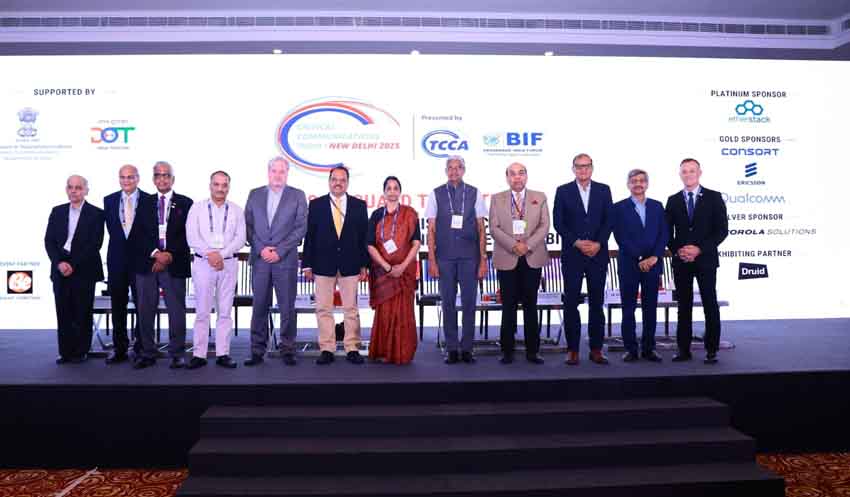
The Communications Conference, Safeguard The Future, concluded successfully in New Delhi, setting a powerful stage for collaboration, knowledge sharing and action toward strengthening the nation’s public safety and emergency preparedness infrastructure. Organised by the Broadband India Forum (BIF) in collaboration with TCCA, this event laid the foundation for India to position itself as a global benchmark in mission-critical communications.
Anil Kumar Lahoti, Chairman, TRAI was the Chief Guest. Other dignitaries at the Inaugural included Lt. Gen. Syed Ata Hasnain (Retd); PVSM, UYSM, AVSM, SM, VSM, Member NDMA Board; Manish Aggarwal, Spl Commissioner, Delhi Police; Sanjai Kumar, CMD, Railtel; and Dr RK Upadhyay, CEO, C-DoT. The conference underscored the critical importance of mission-critical communications in ensuring national security, public safety and effective disaster response.
In his address, the Chief Guest Lahoti said, “This subject carries immense strategic importance for both India and the global community as we navigate an era of rising climate vulnerabilities leading to natural disasters, challenges related to communications in managing urban environments and the increasingly complex security situations. Infrastructure, policies, spectrum and standards are being rapidly developed to build integrated, secure national mission-critical communication systems for India. I congratulate BIF for organizing this pioneering conference.”
Special Guest of Honour, Lt Gen Syed Ata Hasnain (Retd), PVSM, UYSM, AVSM, SM, VSM, Member NDMA Board remarked, “Disaster resilience is not a war against an enemy, but against the unknown. In preparing for uncertainty, communication becomes our strongest weapon – linking agencies, communities and responders in real time. Hence, investing in interoperable, mission-critical networks is important for us to safeguard lives with speed, clarity, and confidence.”
The event fostered a spirit of global collaboration, with participation from leading international organisations and speakers, including Kevin Graham, CEO, TCCA, who highlighted the profound global lessons that countries like India can incorporate to enhance their emergency preparedness. He remarked, “Mission-critical communication users demand trusted, secure and reliable connectivity when and wherever required. By adopting international open standards and best practices in design, deployment and operation, end to end ecosystems, can ensure intra & interagency, national & cross border interoperability and resilience in the face of modern crises.”
Comprehensive discussions during the event explored the potential of mission-critical communications to revolutionise India’s disaster management framework. Sessions covered themes ranging from global case studies and the role of partnerships in securing private networks to the deployment of cutting-edge technologies like MCX solutions, certification processes and real-time communication applications. Key contributors to these discussions included representatives from global technology leaders such as Motorola, Ericsson, Qualcomm and Consort Digital offering perspectives on innovative solutions that can future-proof India’s communication infrastructure.
Reflecting on the need for strong collaboration between public and private stakeholders, Aruna Sundararajan, IAS (Retd), Chairperson, BIF, emphasised the power of partnerships in driving progress. She noted, “The discussions we have had today underline one critical point: safeguarding lives during emergencies is a shared responsibility. We must create a synergy between policymakers, regulators and industry leaders to build technologies and policies that can deliver real impact. This conference is not just a dialogue but the beginning of collective action toward a safer India.”
A highlight of the event was the session on disaster management, where experts from DoT, C-DoT, BSNL and Railtel stressed the integration of mission-critical systems into India’s response strategies. The conference stood out for uniting diverse stakeholders, driving actionable takeaways on preparedness, resilience and global alignment. It concluded with Sundararajan urging participants to turn this momentum into tangible outcomes to strengthen India’s emergency communication framework.
Disclaimer – The details expressed in this post are from the companies responsible for sending this post for publication. This website doesn’t endorse the details published here. Readers are urged to use their own discretion while making a decision about purchasing or using a product related to this company, or using this information in any way. There has been no monetary benefit to the Publisher/Editor/Website Owner for publishing this post and the Website Owner takes no responsibility for the impacts of purchasing or using these products on the reader, or using this information in any way.
 News and Opinions...