
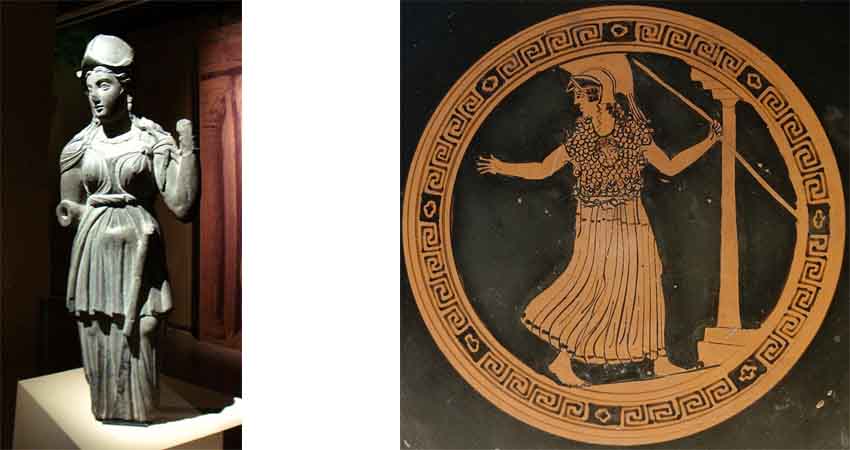
Photo courtesy – Left – Athena in Gandhara (Wikimedia)/Right – Athena in Attic Red c500-450 BCE (Wikimedia)
From Editorial Desk
Dr Archana Verma
In previous posts we discussed the goddess of war figures in Mesopotamia viz., Annana, India viz., Devi and Persia vi., Anahita. In ancient Greece and Rome also there were Artemis-Diana who were hunting goddesses and were converged during Roman Empire. Artemis as associated with another warrior goddess in ancient Greece viz., Athena.
She was a patron deity of cities, especially Athens and was a goddess of war and hence, granted victory to rulers. Her main temple was the Parthenon at Athens. She was conceptualised as a virgin goddess and hence, was known as Parthenos (i.e., virgin). Because of this, her main temple at Athens was called Parthnon.
Scholars are of the opinion that originally she was an Aegean goddess of the palace who presided over the household crafts and was a protector of the king. Her presidence over the artisans comes from this early form.
Plato also likened her to Neith, the pre-dynastic Egyptian-Libyan goddess of hunting, warfare and was regarded as the mother of other deities.
When Alexander conquered the North-Western part of he Indian sub-continent known as Gandhara, the merging of two cultures produced a synthetic art form of sculpture making especially in the Buddhist context. There is a Gandharan woman sculpted in the style of Athena found form Gandhara, now in Lahore Museum, who is referred to as Athena from Gandhara. As the greek culture expanded to different parts of Europe and Asia, Athena was brought there to protect the cities and the ruling figures.
She was later merged with Minerva in the Roman culture.
 News and Opinions...

