
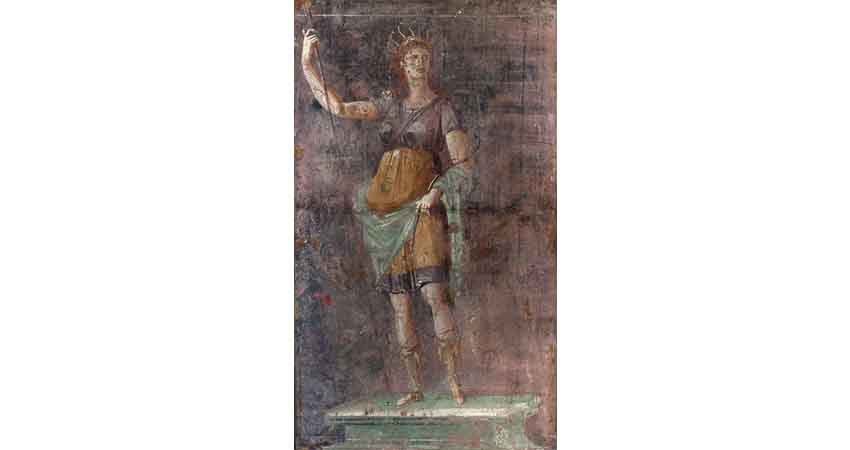
Diana-Artemis at Pompeii/Photo from Wikimedia
From Editorial Desk
Dr Archana Verma
In a previous post I talked about the Indian Goddess who was a warrior and who was associated with forests and mountains. She was a virgin and was regarded as a sister of Vishnu who was identified with the Sun god. She was also associated with the women and household. Her most ancient hymn regards her as a formless supreme deity who can manifest in many forms. In India, she is usually the patron deity of families. I also talked about the Persian goddess Anahita and Greek goddess Artemis and their similarities with the Indian Goddess.
Diana was a Roman goddess of woodlands and countryside. She was also associated with childbirth. Her prime shrine was located by the side of Lake Nemi in the woodlands.
Scholars are of the opinion that in its most ancient form, Roman religion conceptualised its deities in the formless manner. They had nature but not an anthropomorphic form. It was later, when Roman culture subsumed the Greek culture that Roman deities began to have the anthropomorphic forms which were taken from the Greek deities, who always had an anthropomorphic form.
By 3rd century BCE, Diana had assumed most of the characteristics of the Greek goddess Artemis. Temples were erected to worship Diana, who subsumed the identity of Artemis. She was not only the goddess of hunt and woodlands, but was the patron deity of families and protecting deity of cities.
The worship of Diana as the hunting goddess and a goddess of the childbirth and protector of families and cities spread to the other areas of Europe with the expansion of Roman empire.
Thus we can see that the culture of goddess was very similar across a large region, although these goddesses manifested in different forms.
 News and Opinions...
