
From Editorial Desk
Dr Archana Verma
Jagannath Temple at Puri in Orissa is connected to many legends and complicated rituals. A lot of academic research has gone into studying its famous Jagannath chariot festival, which takes place annually. The festival is mixed with many rituals and even before the chariot festival day, many ceremonies take place.
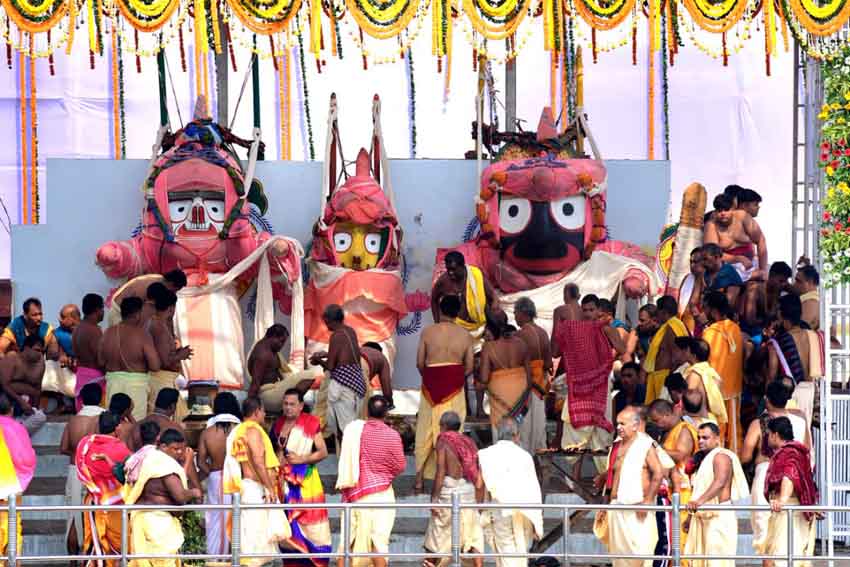
The prominent among them is the bathing festival, celebrated 15 days before the chariot festival in the month of June. It is called Snana Yatra or the bathing procession.
June is the hottest month in India, with temperatures soaring to 45-48 degrees Celsius. When the Full Moon night comes in this month, then the divine triad of Jagannath, his brother Balbhadra and sister Subhadra, who stay inside the main Jagannath temple, are brought out in a ritual procession for a cooling bath on the sea coast of Puri.
A canopy is erected, on which a stage is set for the divine triad to be placed. They are decorated with garlands and a paste of Indian basil leaves is applied on them with chanting of hymns. They are dressed in unstitched bathing garments. Water is brought on the previous day from different forest streams and collected in copper vessels. Priests who identify themselves as descendants of the erstwhile forest communities’ priests (Shavaras and Daitas) take part in this bathing ceremony.
On the evening of the full moon night, the deities are bathed with chanting of hymns and performance of rituals. This is also said to be the birthday of Jagannath.
After this bathing ceremony, the deities are said to fall ill. Hence, they are brought back to the temple and for the next 15 days, the temple doors are shut for the visitors, as the deities are said to be ill. In the main temple, a cloth with painting of the deities is hung on the sanctum.
During these 15 days, herbal medicines are offered to the deities by the priests and sandalwood paste is applied to them to bring down their fever. According to some accounts, bathing ceremony washes off the paint from the wooden idols. Hence, the priests also re-paint the idols.
After 15 days, the temple is opened again and the deities are brought out of the temple to begin their famous chariot festival.
 News and Opinions...
