
Photo – Author
From Editorial Desk
Dr Archana Verma
In an earlier post, we described an ancient Indian hymn to the Goddess who was visualised as a formless supreme deity and could take innumerable forms. While creating the universe, this formless deity took the form of an all powerful Goddess, who could create, sustain, destroy and re-create the universe, but also remained as a formless energy. The earliest hymn to this formless deity who took the form of a Goddess date to 1500 BCE or earlier.
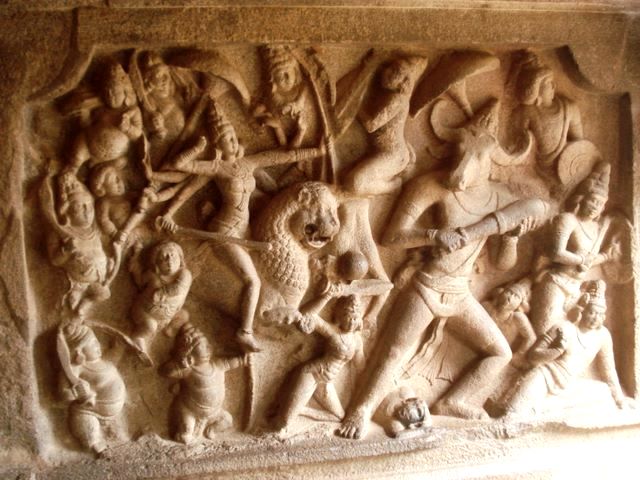
With time, this goddess began to be depicted in sculpture and painting as a woman riding a lion or a tiger and slaying a demon who took the form of a buffalo. Numerous legends grew around the concept of this all powerful, formless deity who could manifest as a powerful Goddess. Legends show even gods praying to her to grant them victory when they couldn’t defeat their rival negative fores depicted as demons.
Further, this Goddess is said to be a sister of Vishnu, who is another masculine manifestation of the formless supreme deity. She is referred to as Devi i.e., “The Goddess.” At some stage, she began to be referred to as Durga and her various names. She is both creator, sustainer and destroyer. Vishnu again, is merged with the identity of Sun, the solar deity, who is regarded as the cause of all lives and is referred to as Surya, Mihir or Mithra.
These manifestations of the formless all-powerful deity into various masculine and feminine forms evolved quite early in Indian history, before 1000 BCE. However, newer forms continued to be evolved till later centuries.
More about the warrior Goddess and solar deity in other cultures in future posts.
 News and Opinions...