
From Opinions Desk
Raghuraj Hegde
Lab tests in the US have discovered content of heavy metals which are toxic and may be carcinogenic. The Ayurvedic practitioners argue that these chemicals are rendered harmless through processing, but this is not scientifically confirmed. Hence, this is an important question – Should Ayurvedic companies display “No toxins and no heavy metals contents” label on their medicines? The author is Ophthalmic Plastic Surgeon and Ophthalmic Oncologist
Are there heavy metals in the Ayurvedic medicines? This is a very important question and one that needs to be answered in comprehensive manner rather than in a casual off-hand way.
As with any chemical found in any substance tested, it has to either be –
1 – A contaminant or
2 – Added purposefully
In Ayurveda it is a little bit of both.
There are two types of medicines in Ayurveda
- Kastha Aushadhi – Wholly plant origin
- Rasa Aushadhi– mineralo-plant origin
If any Kastha Aushadih has been found to contain heavy metals, it could be due to the contamination of the soil in which the herbs are grown or contaminated sources of water – this especially happens with mass production and lenient checks. This is not unlike what happened with pesticides being found in Pepsi and Coca Cola and lead being found in Nestle’s Maggi noodles. Not intentional, but preventable with adequate regulations and checking mechanisms.
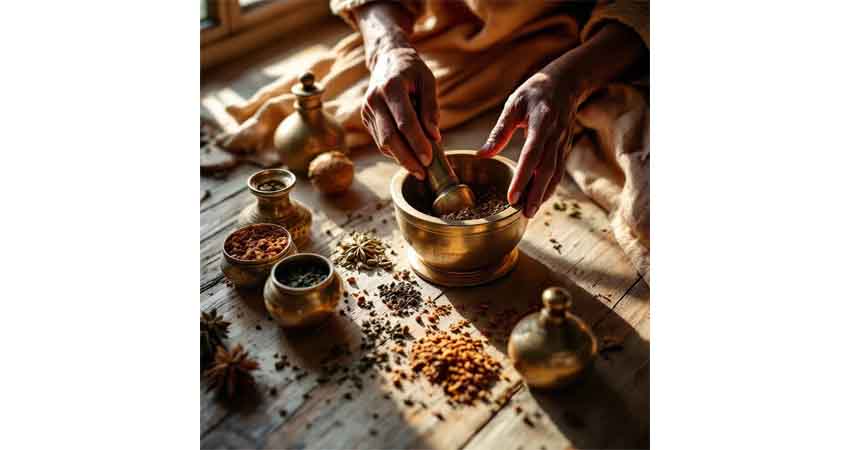
In Rasa Aushadi however to add “potency” to the medicine, a “Bhasma” is added to the herbal preparation. Bhasma is an ash like preparation containing heavy metals from various sources which undergoes a ritualistic purification process which involves calcination (heating mixtures of metal ores in limited supply of air), cattle urine and several other complicated but not sufficiently rational processes. The practitioners argue that this purification process renders the heavy metals non-toxic but actual real world testing on real humans have shown something else.
Since the early 90s, there has been intense scrutiny of Ayurvedic medications in the US. Several independent studies by NIH and outside have brought up the fact that heavy metals in these Rasa medicines are not as harmless as the practitioners claim.
The paper which created a stir worldwide was Lead, Mercury and Arsenic in US – and Indian-Manufactured Ayurvedic Medicines Sold via the Internet by Saper et al (2004).
It led to banning of several Ayurvedic products in several countries.
There were some sampling errors since most of the drugs tested were from regular US groceries. In the US, Ayurvedic medicines are known as health supplements and are not required by their federal law to comply to food and drug safety regulations. Several researches pointed out those and were duly noted and accounted for in several follow up studies by the same group.
However, this group was not the only one who proved the harmful effects of some Ayurvedic products. Centres for Disease Control and Prevention reported several cases of lead poisoning. See Link.
They even issued a warning.
The implicated products were all directly imported by the users from India, and there is no regulatory public health authority in the United States for these products. Lack of quality control of herbal products represents a public health threat requiring increased recognition among Ayurvedic practitioners and consumers regarding the potential toxicity from metals in such preparations. As use of alternative medications becomes more common in the US, it is imperative that both traditional and non-traditional medical practitioners communicate effectively with their patients regarding the use and potential risks of unregulated products.
A 2002 systematic review of many studies found that 64% of samples collected in India had lead, mercury, arsenic and cadmium. A 2005 paper showed that 40 percent of 115 people tested who were using Ayurvedic products were found to have lead poisoning.
Many more studies below
Chronic arsenic poisoning following ayurvedic medication.
Toxic element contamination of natural health products and pharmaceutical preparations.
Lead poisoning in pregnant women who used Ayurvedic medications from India–New York City, 2011-2012.
I could literally go on since there are more papers on heavy metals in these drugs being harmful than any papers actually showing any actual benefit of any ayurvedic preparation.
The Ayurvedic practioners themselves are to blame for this embargo. Instead of conducting well designed studies to prove the benefits of Ayurvedic medications, they first denied that heavy metals in Ayurvedic drugs were harmful. They then started publishing half baked poorly designed studies in equally low standing journals. The last nail on the coffin was they started quoting these kind of studies.
Ayurveda and other Indian system of medicine use metals, but their use is also amply described in Chinese and Egyptian civilisation in 2500 BCE. Bhasma are unique ayurvedic metallic/minerals preparation, treated with herbal juice or decoction and used in Ayurveda, which are known in Indian subcontinent since 7th century CE; and widely recommended for treatment of a variety of chronic ailments. Animal’s derivative such as horns, shells, feathers with metallic, non-metallic and herbs are normally administered as Bhasma.
Bhasma which contains metals, minerals and animal products, the manufacturing process plays a specific role in the raw material mixture in the final product. These could be important chemical markers for Bhasma prepared using a particular method. As a result of different stages of processing techniques like shodhana (which involves roasting, with addition of herbal juices and continuous stirring) and marana [which involves bhavana (wet trituration) and puta system of heating], the particle size reduces significantly, which may facilitate absorption and assimilation of the drug into the body system. The particle size in the Bhasma is 1-2 μ, which could be specified as the criterion for the final product conforming to all the traditional parameters under Bhasma pariksha (examination of properly prepared Bhasma). Although Bhasmas are complex materials, physicochemical analysis using modern techniques will be most attractive for the standardisation of Bhasma medicines.
If you are patient enough (like me) to go through the whole elaborate paper which reads more like a religious text than a scientific paper, you would realise that there is no rationale for any of those complicated processes. There is not even an explanation as to how this process makes the heavy metals non-toxic and we are expected to believe in their random statements.
Instead of regulating Ayurvedic products and having checks in place at the manufacturing level and then having a post-market surveillance programme, the Ayurvedic Vaids then go on to cite “poisonous chemotherapy” and “Big Pharma” to try to discredit modern medicine. They could achieve a lot by acknowledging their flawed assumptions.
They should have gained respect of modern medical doctors by rationally explaining some of their concoctions and preventing any quack to produce and sell products in the name of Ayurveda. Instead, they take refuge in tradition, nationalism and scientific fraud.
Just because something has been done since 5000 years doesn’t make it right. If so, blood letting for diseases would still be a valid treatment today. The premise of modern medicine is that it keeps changing with new knowledge unlike Ayurveda, which is decaying by clutching on to old scriptures, denying that any new knowledge exists.
It is always a cost/benefit when it comes to consuming medicines. For example, Mercury has anti-bacterial properties and has been used in the medieval era as medicine. However, using mercury to treat an infection in today’s day and age, would be considered malpractice and the doctor administering it could be charged with homicide. The benefits should always far outweigh the costs.
One should consume medicine to get better when sick and not to get sick by consuming medications. Ingesting mercury, lead, arsenic and cadmium for a benefit of dubious value which has not even been proved by any good study would be as good as people willfully poisoning themselves, albeit a little slowly.
Note – The views expressed in this article are those of the author and not of this platform and its Editor.
 News and Opinions...