
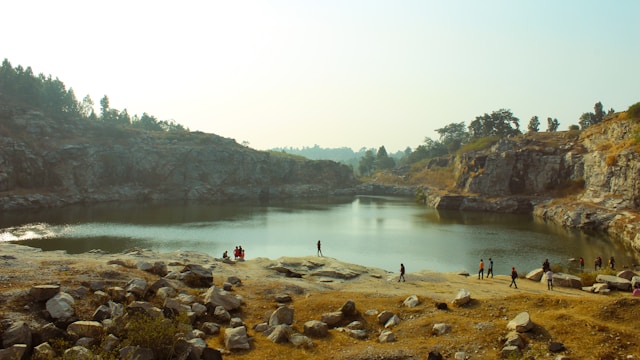
Photo courtesy – Supratik Deshmukh/Unsplash
From News Desk
The UNESCO Global Geoparks Network, which this year celebrates its 10th anniversary, brings together territories recognised for their rich geological heritage – rock formations, mountain or volcanic ranges, caves, canyons, fossil sites or ancient desert landscapes – which bear witness to our planet’s history, evolution and climate. These sites are also places for conservation and environmental education, where local and indigenous communities can promote their culture and know-how.
“In ten years, UNESCO Geoparks have become models for the conservation of geological heritage. But their role goes much further: they support educational projects, promote sustainable tourism and keep the knowledge and traditions of these territories alive through the active participation of local and indigenous communities. This is the case, for example, in Iceland’s Katla Geopark, where local schools are actively involved in the scientific research that is carried out on this landscape, which preserves the memory of volcanic and glacial systems through its lava flows and black sand beaches, said Audrey AzoulayUNESCO Director-General.
Each year, new sites are added to the network by decision of UNESCO’s Executive Board, after an evaluation of the applications by the Global Geoparks Council made up of international experts.
The 16 newly designated geoparks are located in China, Democratic People’s Republic of Korea –marking its first geopark and contribution to the protection of the shared mountain range with China – Ecuador, Indonesia, Italy, Norway, Republic of Korea, Saudi Arabia — hosting its first two geoparks — Spain, United Kingdom and Viet Nam.
 News and Opinions...